The short answer: choose carpet (or a runner over hardwood) if safety is your top priority — households with young kids, older adults, or dogs that treat the staircase like a racetrack. Choose hardwood if durability and resale value matter most — wood stairs last decades, look premium, and are what buyers in Johnson County increasingly expect. Cost-wise, they’re not close: carpeting a typical 13-step staircase runs $400 to $1,200, while hardwood stairs run $1,500 to $3,000+.
The good news is there’s also a third option that captures the best of both. Here’s the full comparison.
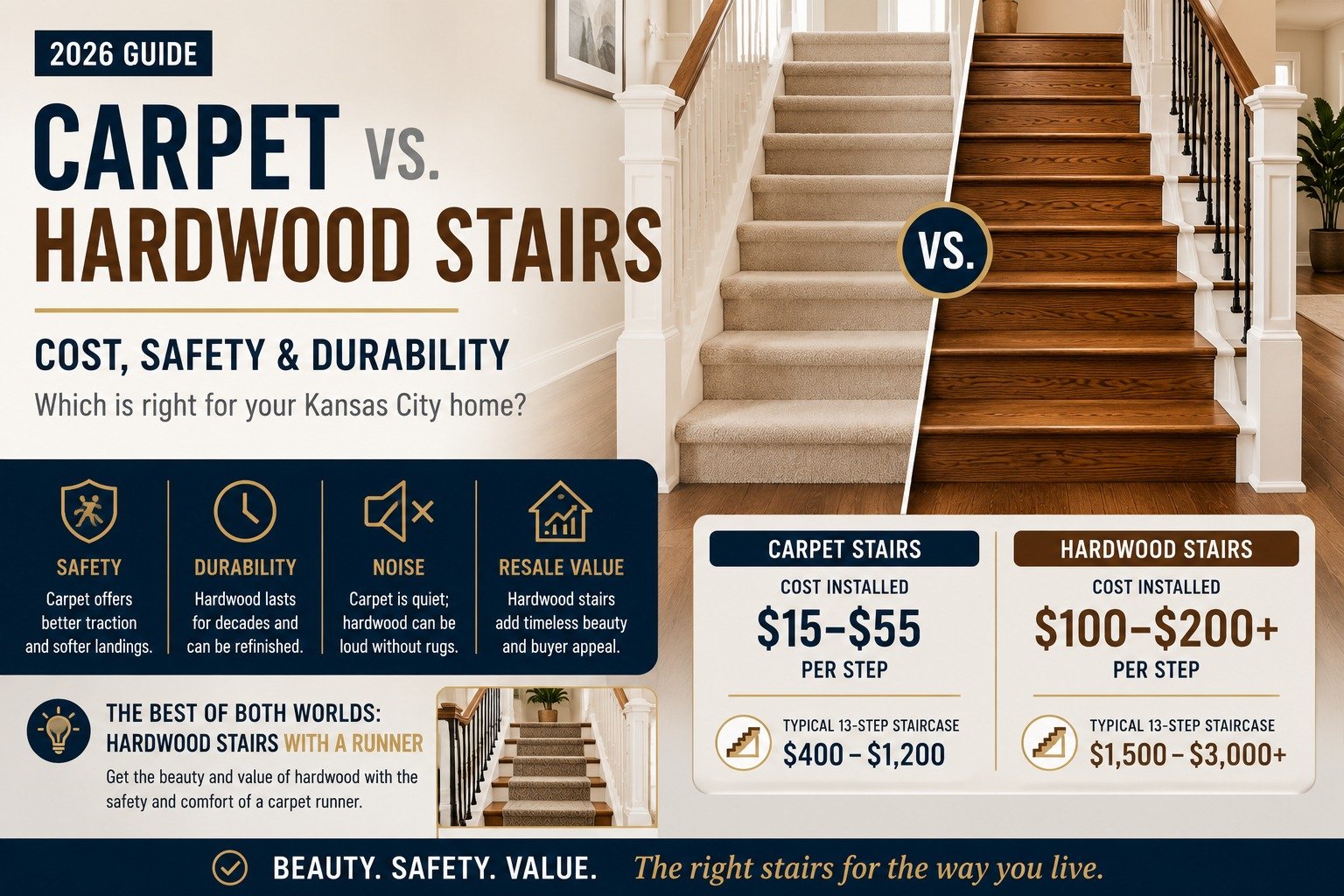
Carpet vs Hardwood Stairs: Quick Comparison
| Factor | Carpet Stairs | Hardwood Stairs |
|---|---|---|
| Cost per step (installed) | $15 – $55 | $100 – $200+ |
| Typical 13-step staircase | $400 – $1,200 | $1,500 – $3,000+ |
| Slip resistance | Excellent | Fair (can be improved) |
| Noise | Very quiet | Loud without treatment |
| Durability | 5 – 10 years | 25 – 50+ years |
| Pet claw resistance | Traps fur, hides scratches | Shows scratches, easy to refinish |
| Resale value impact | Neutral | Positive in most KC markets |
| Cleaning | Vacuum; stairs wear fastest in home | Sweep and damp mop |
What Do Stairs Cost in 2026?
Carpeted stairs: $15–$55 per step installed. Budget polyester in a simple waterfall installation starts around $10–$15 per step; mid-grade nylon runs $14–$20; premium cap-and-band installations with pattern matching reach $20–$45+. Add $1–$2 per step for old carpet removal.
Hardwood stairs: $100–$200+ per step installed. That covers new treads, risers, and finishing. Custom features — curved staircases, stained-to-match handrails, open-tread designs — push costs to $300+ per step.
The hidden middle option: $40–$75 per step. Many Kansas City homes built from the 1980s onward have solid wood treads hiding under carpeted stairs. If yours does, we can pull the carpet, sand, stain, and refinish the existing wood for roughly a third of the cost of new hardwood stairs. It’s the same logic as refinishing floors instead of replacing them — if good wood is already there, use it.
Safety: The Case for Carpet
Stairs are where household falls happen, and this is carpet’s strongest argument:
– Traction. Carpet grips socks, slippers, and paws far better than any hard surface.
– Softer landings. If a fall happens, carpet meaningfully reduces injury severity — the reason families with toddlers and homeowners planning to age in place often keep carpet on stairs even after replacing it everywhere else.
– Pet confidence. Dogs — especially older ones — hesitate on slick wood stairs and can injure themselves slipping. If your household includes pets, this pairs with everything in our guide to the best flooring for homes with pets and kids.
Hardwood stairs aren’t unsafe, but bare wood is slicker, particularly in socks. If you want wood, plan on one of the fixes below.
Durability & Maintenance: The Case for Hardwood
Stairs take more concentrated wear than any floor in your home — every trip lands on the same 8-inch strip of each tread.
– Carpet on stairs wears out in 5–10 years, and it fails visibly: crushed pile and a worn path up the center, usually years before the bedroom carpet upstairs shows any wear.
– Hardwood treads last 25–50+ years and can be sanded and refinished when they dull, rather than replaced.
– Cleaning favors wood. Vacuuming stairs is the most awkward job in the house; wood needs a sweep and occasional damp mop. For allergy households, wood also doesn’t trap dander and dust the way carpet pile does.
– Wood shrugs off Kansas seasons better on stairs than you’d think. Treads are thick and well-supported, so the humidity swings that stress Midwest floors affect stairs less than open floor fields.
Resale Value: What Kansas City Buyers Want
In most Johnson County and Kansas City metro listings, hardwood stairs photograph better, show better, and signal a well-maintained home — especially when the main level already has wood floors and carpeted stairs would break the visual line. As we covered in how flooring affects your home’s resale value, buyers read flooring as a proxy for overall home care.
One nuance: in family-oriented neighborhoods, some buyers actually prefer carpeted stairs for the safety reasons above. Which is why the option below has become our most-requested stair project.
The Best of Both: Hardwood Stairs with a Runner
A carpet or wool runner over hardwood treads has become the signature look in remodeled Overland Park and Leawood homes, and for good reason:
– Safety of carpet where feet actually land
– Beauty of exposed wood on the edges of each tread
– Replaceable wear surface — when the runner wears out in 8–10 years, you replace a runner, not a staircase
– Quieter than bare wood, which matters when bedrooms sit at the top of the stairs
Runners typically add $500–$2,000+ to a hardwood staircase depending on material and stair count. Other slip-resistance options for bare wood stairs include clear anti-slip strips and matte finishes with higher traction than gloss.
Which Should You Choose?
Choose carpet if: budget is tight, you have young children or older adults at home, noise matters, or the staircase leads to a basement or secondary space.
Choose hardwood if: your main level already has wood floors, you’re planning to sell within a few years, you want a decades-long solution, or allergies make carpet a problem.
Choose hardwood + runner if: you want the premium look and the safety — and don’t mind the higher combined budget.
Check under your carpet first, always. If solid treads are hiding under there, refinishing changes the entire cost equation.
Stair Remodeling in Kansas City
Star Flooring builds, refinishes, and carpets staircases across the Kansas City metro — from full stair building and carpeting projects to carpet-to-hardwood conversions that match your existing hardwood flooring. We serve Lenexa, Overland Park, Olathe, Leawood, Shawnee, and Lee’s Summit. Contact us for a free staircase assessment or call +1 (816) 934-1016.
Frequently Asked Questions
Is carpet or hardwood better for stairs?
Carpet is better for safety and budget; hardwood is better for durability and resale value. Many homeowners get both by installing hardwood treads with a carpet runner — carpet’s traction where feet land, wood’s look and longevity everywhere else.
How much does it cost to redo a staircase in 2026?
Carpeting a typical 13-step staircase costs $400–$1,200 installed. New hardwood stairs cost $1,500–$3,000+. If solid wood treads already exist under old carpet, refinishing them costs roughly $40–$75 per step — about $500–$1,000 for a full staircase.
Are hardwood stairs slippery?
Bare hardwood stairs are slicker than carpet, especially in socks. Slip resistance improves significantly with a carpet runner, clear anti-slip strips, or a matte traction finish instead of gloss.
Can you put LVP or laminate on stairs?
Yes — both can be installed on stairs with matching stair-nosing pieces, typically at $40–$100 per step. LVP handles the job well; laminate needs quality nosing to avoid chipping at tread edges. Solid wood treads remain the most durable stair surface.
Is there usually wood under carpeted stairs?
Often, yes. Many homes have solid construction-grade treads under carpet — sometimes finish-quality oak. A flooring pro can lift a corner of carpet in minutes to check. If the wood is finish-grade, refinishing costs a fraction of new stairs.
Leave A Comment